
AWF Robotaxi WG releases AutoE2E, an open-source end-to-end AI model designed to scale from L2++ to L4 autonomy
Advancing toward commercialization led by the Autoware Foundation and TIER IV.
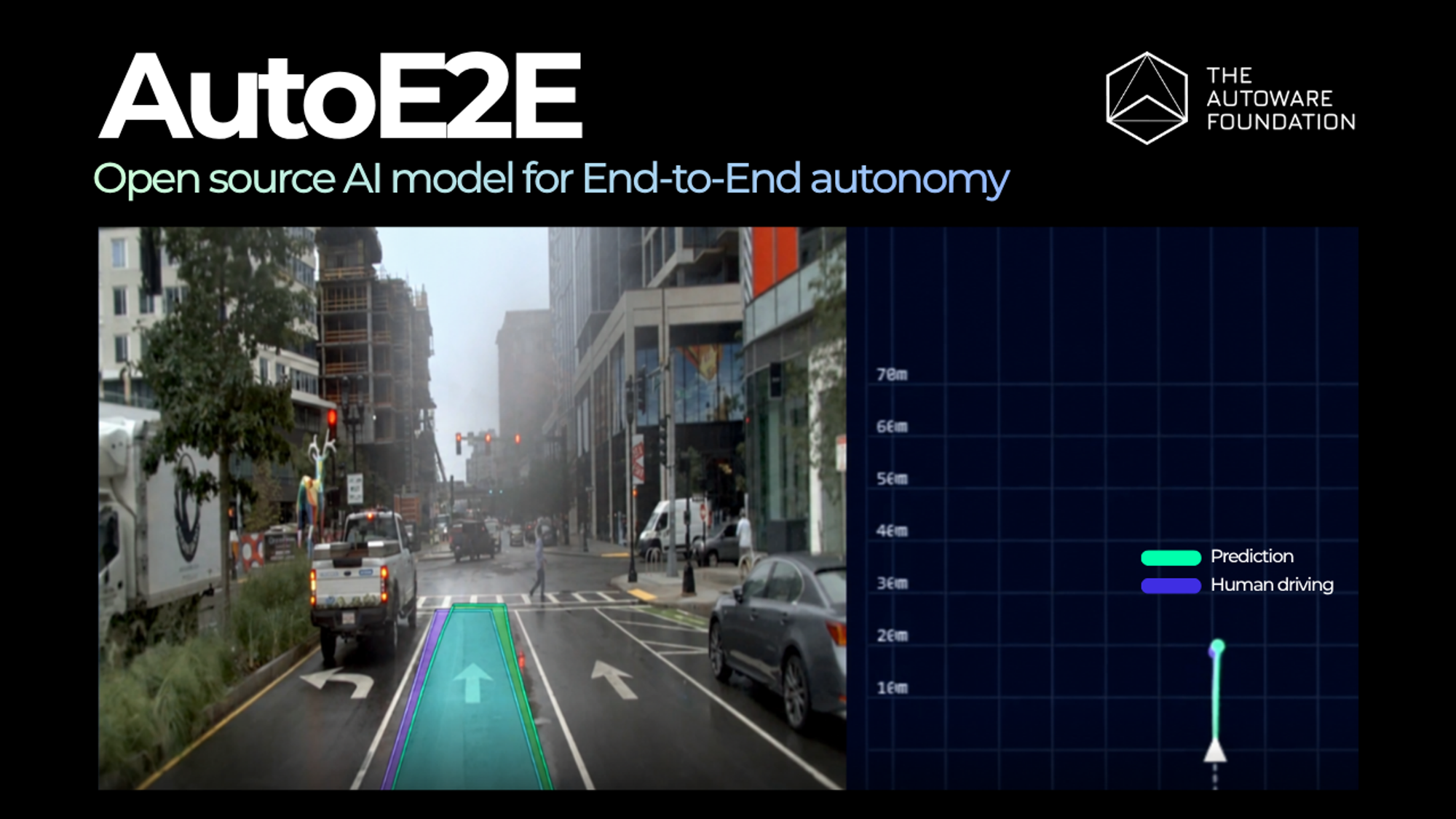
The Robotaxi Working Group (WG) of the Autoware Foundation (AWF), sponsored by TIER IV, has released AutoE2E, an open-source end-to-end (E2E) AI model designed for applications ranging from L2++ hands-free driving assistance to future L4 driverless mobility services. With just 79.9 million parameters, the model combines a compact architecture with promising trajectory prediction performance.
Big performance, tiny footprint
AutoE2E has been integrated with Autoware, for open-loop testing and performance evaluation within the Autoware platform and ecosystem. On KITScenes-Multimodal validation data, the fine-tuned model achieved an average displacement error (ADE) of 0.744 meters over a three-second horizon, ranking second among eight open-weight model configurations included in the benchmark comparison. Real-vehicle closed-loop testing is underway as AWF and TIER IV advance the technology toward commercialization.
AutoE2E supports low cost camera-only sensor setups for hands-free driving on highways and city streets, and can be paired with LiDAR and radar safety layers to enable fully driverless applications.
It’s available today: the code is live on GitHub under the permissive Apache 2.0 license for research and commercial use, and the v1.0 checkpoints are on Hugging Face. Developers can build on the model and adapt it to their own applications.
Reflexes, imagination and judgment
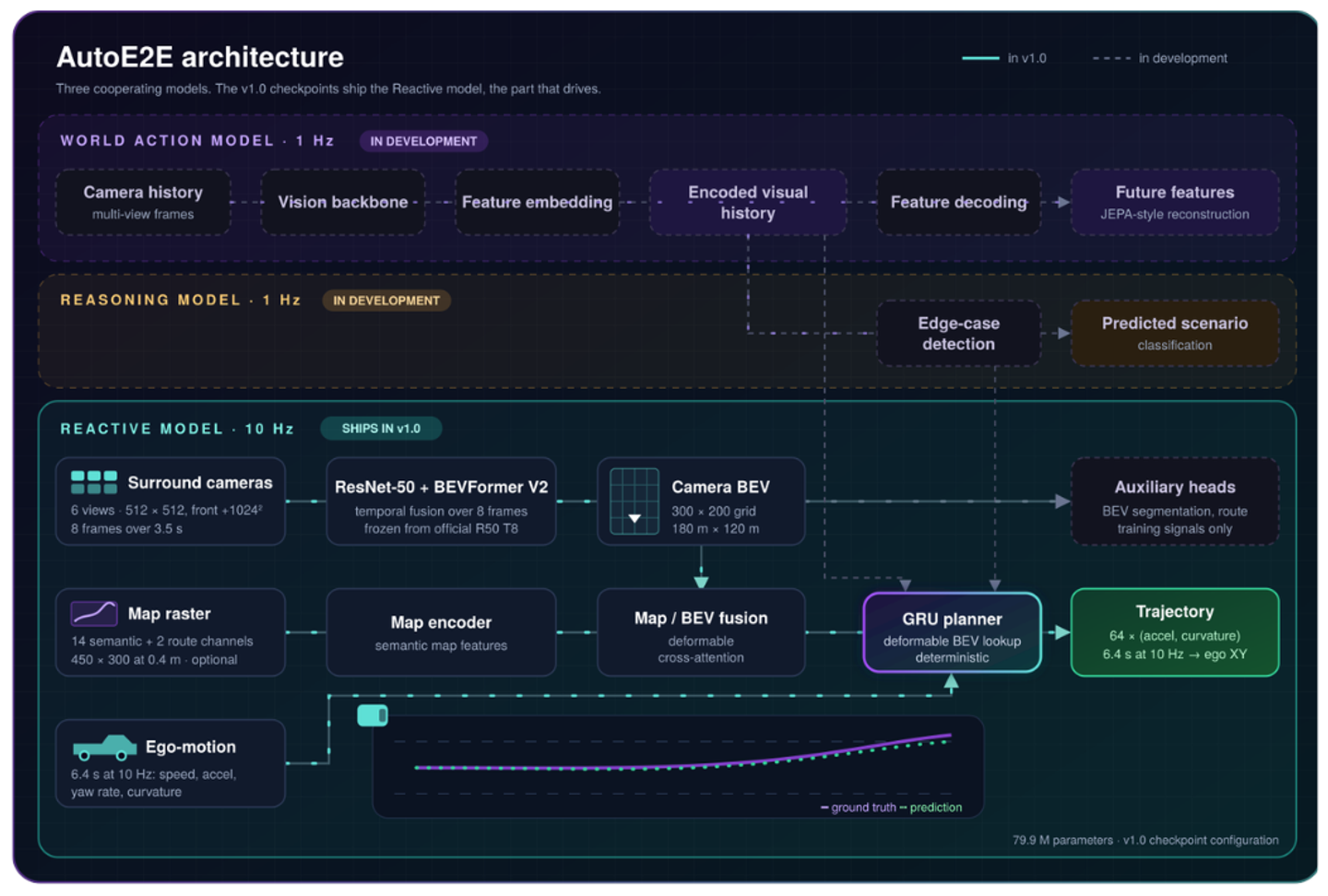
AutoE2E uses a fast–slow architecture for end-to-end autonomy. The fast layer plans the vehicle’s trajectory, while two slow layers are designed to predict how the scene will evolve and reason about what action to take.
- Reflexes: the Reactive model (10 Hz). Ten times a second, it fuses six camera views into a bird’s-eye picture of the road and plots the next 6.4 seconds of acceleration and steering. This is the layer that drives.
- Imagination: a JEPA world model (1 Hz). Instead of rendering pixels, it predicts how the scene itself will evolve, giving the planner a feel for what’s about to happen.
- Judgment: language-free reasoning (1 Hz). It works out why the car should act, like easing off for a pedestrian about to cross, without generating a single word.
AutoE2E v1.0 includes the reflexes. The world model and reasoning layers are being developed to work with the same planner; which means every result below was achieved by the Reactive model alone.
Open-loop benchmark results
On KITScenes-Multimodal validation, the fine-tuned AutoE2E model achieved an average displacement error (ADE) of 0.744 meters over three seconds, ranking second by ADE among eight reported model configurations.
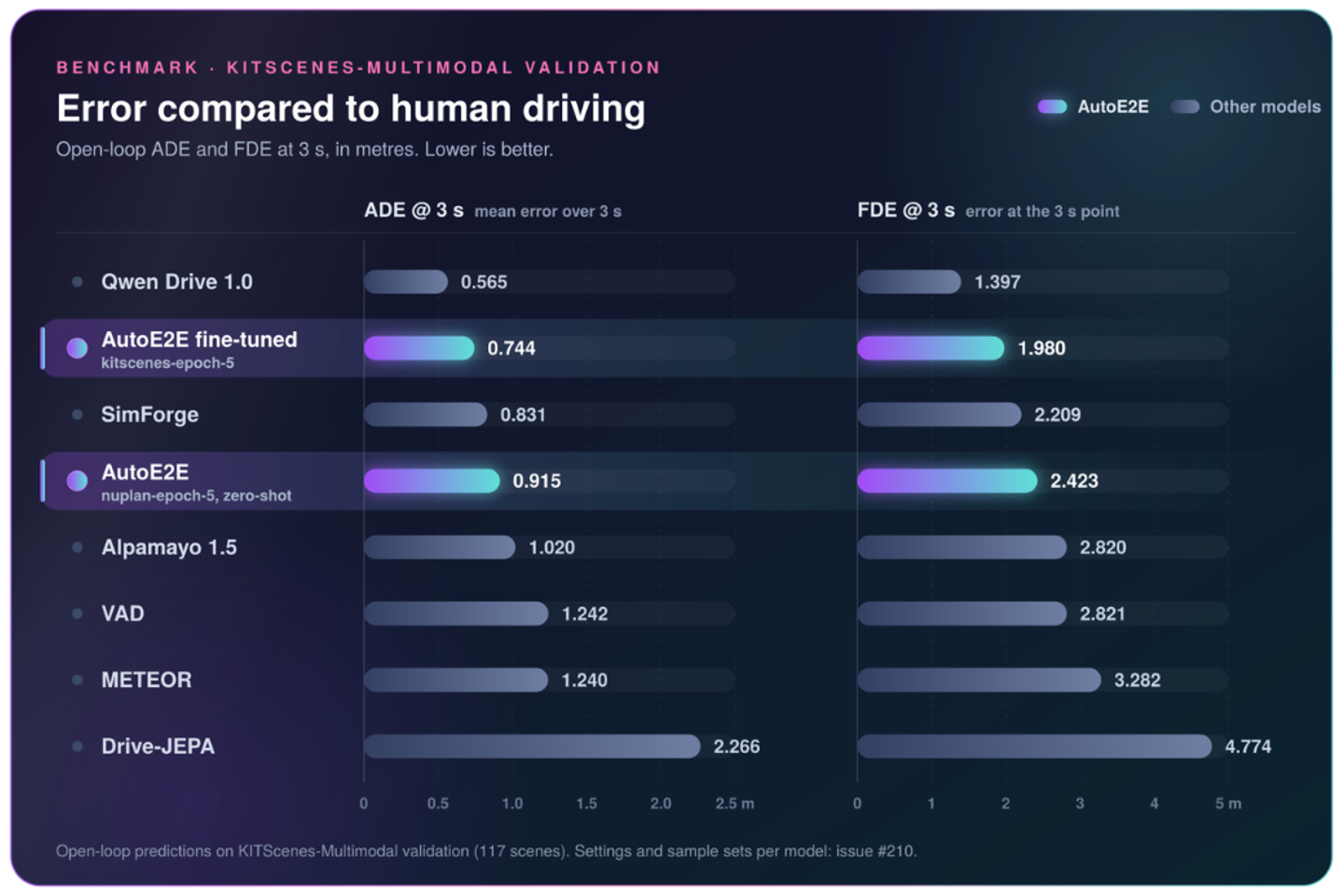
In benchmark testing, all models were scored open-loop, predicting the next 3 seconds from logged camera frames and measured against the path the human driver actually took. Inputs vary by model; AutoE2E also receives a map raster and route.
Compact architecture for automotive computing
With 79.9 million parameters (approximately 0.08 billion), AutoE2E provides a compact foundation for further optimization on automotive system-on-chips (SoCs), where compute efficiency, power consumption and cost are important design considerations.
AWF and TIER IV are pursuing model development and automotive SoC optimization as part of the pathway from open-source research to practical deployment. The model’s deployment performance and resource requirements remain subject to platform-specific evaluation.
Open for everyone to build on
AutoE2E source code is available on GitHub under Apache 2.0, enabling research and commercial use. The v1.0 checkpoints are available on Hugging Face.
Developers can inspect the code, retrain or fine-tune the model on their own data, and integrate it into broader autonomous driving solutions, subject to applicable license terms, and contribute through the Robotaxi Working Group.
Next stop: the open road in 2027
AutoE2E is already integrated with Autoware for open-loop evaluation. Real-vehicle closed-loop testing is underway to assess the behavior of the integrated system in interactive driving conditions. Further on-road trials are planned for 2027, alongside continued development and automotive SoC optimization. These steps are intended to support eventual commercialization; L4 capability remains a development goal.
The project was developed openly through the AWF Robotaxi WG with sponsorship from TIER IV. AWF and TIER IV welcome participation from the global Autoware community:
AutoE2E is built in the open, and there’s room for you. Jump in:
- Star and explore the code on GitHub
- Download the checkpoints from Hugging Face
About Autoware Foundation
The Autoware Foundation is a non-profit organization dedicated to advancing open-source software for physical AI. By bringing together industry leaders, researchers, and developers, the Foundation fosters collaboration to accelerate the safe deployment of autonomous driving technologies worldwide.
Media Contact


